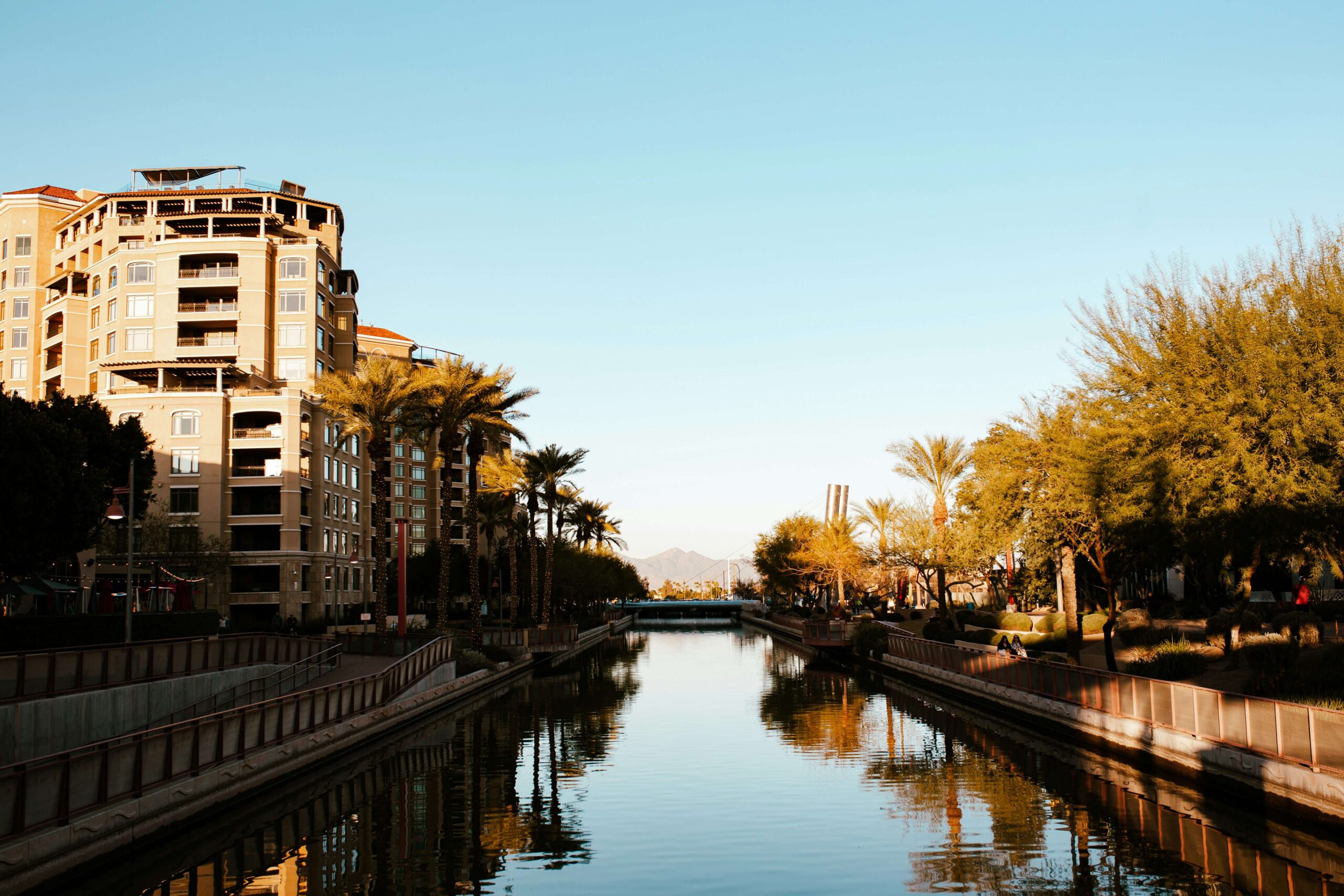
I grew up in Arizona, and Scottsdale has never felt like one singular place to me. It stretches more than 30 miles from south to north, changing from midcentury ranch homes and Old Town restaurants to manicured golf communities, granite boulders and wide-open Sonoran Desert along the way.
So where exactly does South Scottsdale become Central Scottsdale? When are you officially in North Scottsdale? And, more importantly, what does any of that mean when you’re deciding where to live?
The boundaries aren’t perfectly defined, but the differences are very real. I tend to break Scottsdale into three broad areas: South, Central and North.
Here’s where I draw the lines, what changes as you cross them and what you should know before deciding which Scottsdale feels most like yours.
First, a note about the map
There aren’t official lines separating South, Central and North Scottsdale. Ask three locals where Central Scottsdale begins and you may get three slightly different answers.
For the sake of actually making the city understandable, this is roughly how I think about it:
South Scottsdale
Old Town and generally south of Chaparral Road
Central Scottsdale
The broad middle, including McCormick Ranch, Gainey and the Shea corridor
North Scottsdale
Generally north of the Loop 101
These aren’t hard borders. They’re simply a useful way to understand how the housing, landscape and everyday experience of Scottsdale change as you head north.
South Scottsdale | 85250 · 85251 · 85257
Older homes, livelier and closer to the action
South Scottsdale is the oldest and most urban part of the city. This is where you’ll find Old Town, along with established neighborhoods full of ranch homes, midcentury architecture, remodels and new construction mixed into older streets.
It’s also the most connected to the central Valley. Tempe and ASU are just south, Phoenix is immediately west and Sky Harbor is a much easier drive than it is from far North Scottsdale.
Old Town itself is Scottsdale’s most concentrated pocket for restaurants, galleries, hotels, shopping and nightlife. It’s also one of the few parts of the city where you can realistically park the car and spend a good chunk of the day on foot.
The residential experience changes quickly once you leave the center of Old Town, but South Scottsdale generally feels busier, more energetic and more connected than the rest of the city.
Madison’s Note
If you value restaurants, airport access, character and being close to the rest of the Valley, this could be an awesome choice!
What I’d know before buying here
The individual street matters. Proximity to Old Town can be a huge perk, but it can also mean more activity, traffic or short-term rentals depending on exactly where you land. If you want character and centrality, I’d look here carefully rather than judging the entire area by one neighborhood.
Central Scottsdale | 85254 · 85258 · 85259 · 85260
The middle ground, in a very good way
Central Scottsdale is probably the hardest section to define on a map, but one of the easiest to understand once you’re driving through it.
This is the Scottsdale of McCormick Ranch and Gainey Ranch, mature trees, established neighborhoods, greenbelts, golf courses and homes that have had a little time to develop some personality.
McCormick Ranch is a good example. Its mature landscaping and established streets feel noticeably different from the more native desert environment you’ll find farther north. The Indian Bend Wash Greenbelt also gives this part of Scottsdale a surprisingly green feel in places.
But Central Scottsdale’s biggest advantage may simply be where it sits. Paradise Valley is west. Old Town is south. North Scottsdale is an easy drive north, and the 101 keeps much of the Valley within reasonable reach.
Right in between everything is sometimes exactly where you want to be.
And then there’s 85254
You’ll hear 85254 called the “magic ZIP code.” It can have a Scottsdale mailing address even when the property itself is within the City of Phoenix, with Paradise Valley nearby too.
Madison’s Note
A Scottsdale address doesn’t always mean you’re buying inside the City of Scottsdale. In 85254 especially, I always want to know the actual municipality because city services, rules and taxes can follow the jurisdiction, not the name printed on the listing.
North Scottsdale | 85255 · 85262 · 85266
Desert, golf and more room to spread out
Cross north of the 101 and Scottsdale begins another transition.
The city gets less urban. The Sonoran Desert becomes much more prominent. The McDowell Mountains start playing a larger role in the landscape, and gated communities, golf and newer development become more common.
This is where you’ll find areas and communities like DC Ranch, Silverleaf, Troon, Pinnacle Peak and, farther north, Desert Mountain.
North Scottsdale isn’t one particular housing type. You can find more compact homes inside highly amenitized communities, large custom estates, golf properties, newer construction and homes tucked into native desert.
The pace changes too. You’re generally driving to restaurants, shopping and everyday errands. And while North Scottsdale has plenty of its own amenities, Old Town, Phoenix and Sky Harbor are simply farther away.
For some people, that’s the compromise. For others, that’s the entire appeal.
Madison’s Note
“North Scottsdale” does not automatically mean acreage or total privacy. Look at the individual lot, the homes around it, road exposure and elevation. A gate and a high price point don’t tell you how private the backyard actually feels.
So, which part of Scottsdale makes the most sense?
I’d start with the things you’ll do repeatedly, not the things you’ll do when someone comes to visit.
If you want restaurants nearby, easier airport access and a more energetic setting, South Scottsdale probably deserves more attention.
If you want established neighborhoods, mature landscaping and a location that makes it relatively easy to go north or south, I’d spend time in Central Scottsdale.
And if the version of Arizona in your head involves mountains, saguaros, golf, gated communities and more separation from the center of the Valley, start looking at North Scottsdale.
None is the “better” Scottsdale. They’re just surprisingly different places to live for three areas sharing the same name.
Madison’s Note
Before you fall too hard for a house, map the boring stuff: your airport run, school or work route, favorite kinds of restaurants, golf or gym and the places you’ll actually go every week. That’s usually when the right part of Scottsdale starts becoming obvious.
Frequently asked
Scottsdale, quickly explained
For relocation purposes, it’s helpful to think of Scottsdale as South Scottsdale and Old Town, Central Scottsdale and North Scottsdale. They aren’t official districts, but the shorthand is useful because housing, landscape and day-to-day convenience change considerably as you head north.
There isn’t one official dividing line, but for house-hunting purposes I generally think of North Scottsdale as beginning around the Loop 101 and extending north toward areas such as DC Ranch, Troon, Pinnacle Peak and Desert Mountain.
South Scottsdale is generally the closest of the three broad areas to Phoenix Sky Harbor International Airport. Airport access becomes a more meaningful consideration as you move farther north.
It’s common local shorthand rather than an official city district. I use it to describe the broad middle of Scottsdale, including established areas such as McCormick Ranch and Gainey Ranch and the Shea and Cactus corridors.
Photo Matthew Hamilton