Photo: Suchan, Getty Images
If you spend enough time in South Scottsdale, you eventually realize there’s a second way of getting around town.
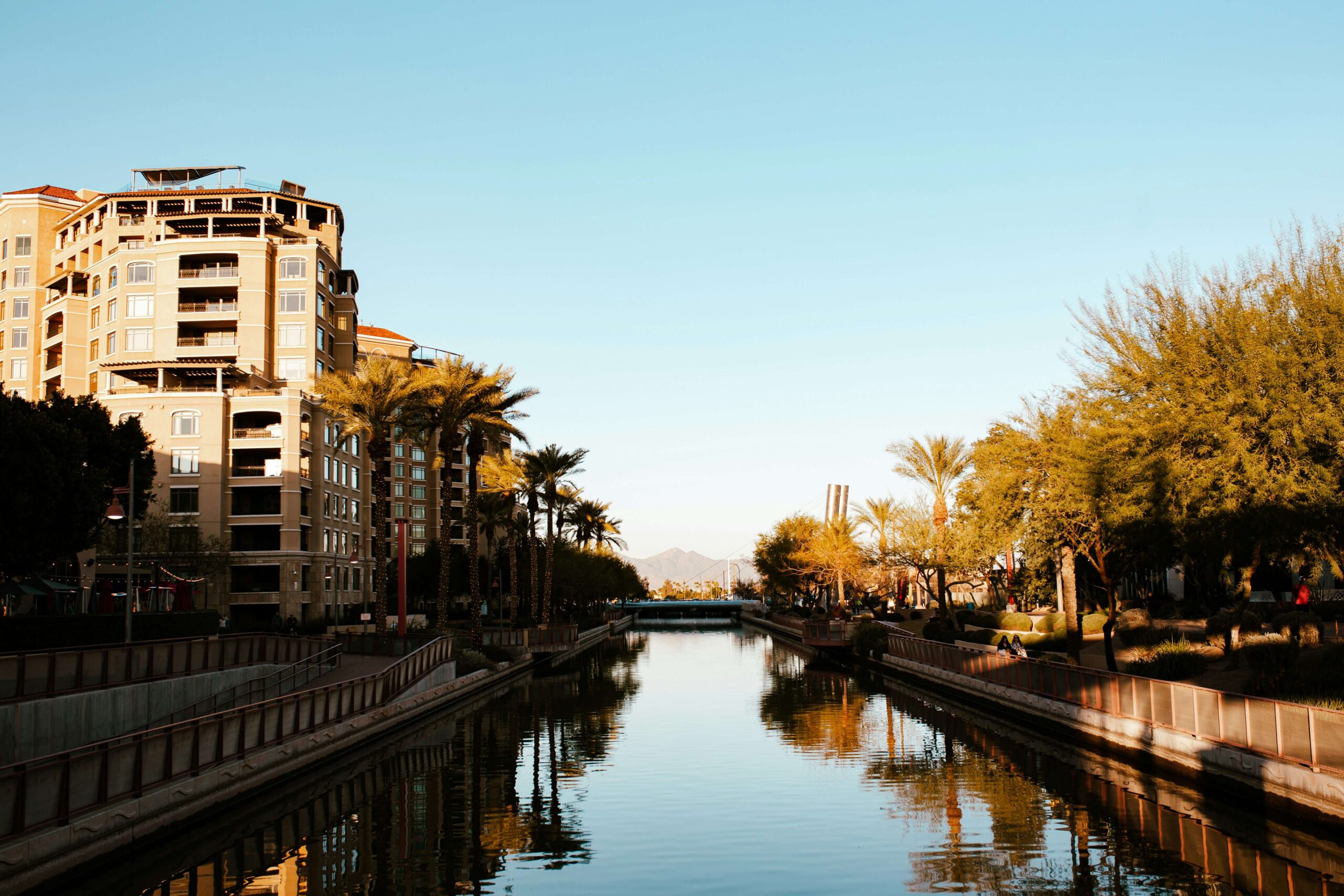
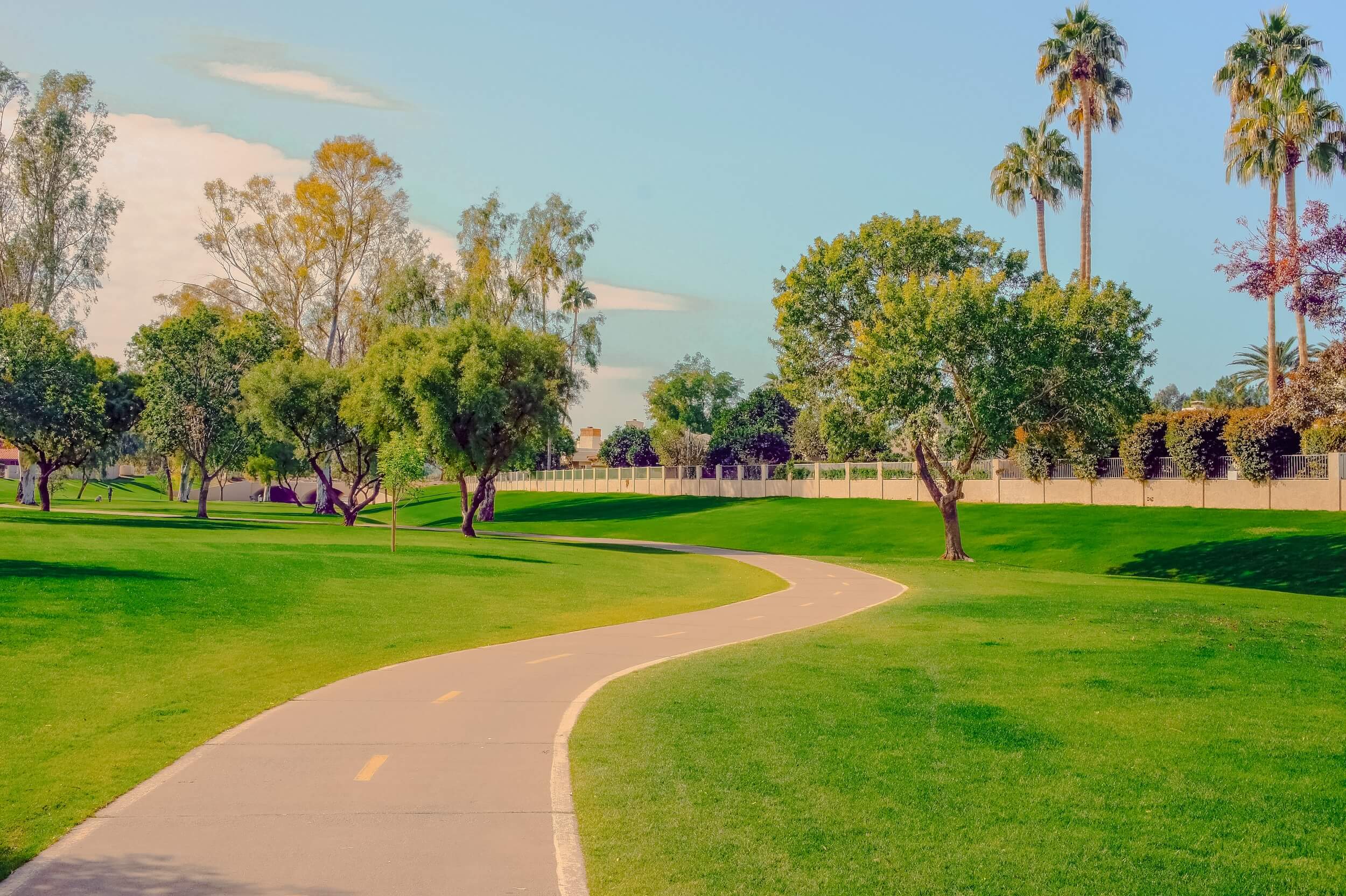
It runs behind neighborhoods, ducks underneath major roads, passes lakes and golf courses, cuts through parks and, for roughly 11 miles, makes a fairly suburban city feel surprisingly connected.
Officially, it’s the Indian Bend Wash Greenbelt.
Locally, it’s mostly just the Greenbelt or the Scottsdale Greenbelt.
And if you’re looking at homes anywhere near it, I think it’s one of those Scottsdale features that deserves considerably more attention than it gets.
It started with a flooding problem
The Greenbelt exists because Scottsdale had a problem.
Indian Bend Wash is a natural drainage corridor, and before the Greenbelt was built, seasonal flooding could turn it into a significant divide through the growing city.
In the early 1960s, the U.S. Army Corps of Engineers proposed a solution that was fairly typical of the era: contain the water in a massive concrete channel.
Scottsdale initially supported the idea.
But, thankfully, residents pushed back.
Landscape architect Bill Walton was among the people advocating for something very different: rather than giving over the center of the city to concrete infrastructure, why not create a landscaped floodplain that could carry stormwater when necessary and function as parks and recreation space the rest of the time?
That idea eventually won.
Construction on the Indian Bend Wash Greenbelt Flood Control Project began in the 1970s, and the completed system was dedicated in 1985. Today, what could have been an unsightly and unusable concrete channel is an 11-mile corridor of parks, lakes, paths and golf courses running through the heart of Scottsdale.
It is still flood infrastructure.
It just happens to be unusually lovely flood infrastructure.
Madison’s Note
This is one of my favorite pieces of Scottsdale history because it explains something about the city that isn’t immediately obvious. A lot of what feels established and green through central Scottsdale isn’t accidental. There was a very deliberate decision made decades ago to make infrastructure part of the community rather than simply something the community had to live around.
So, where exactly is the Scottsdale Greenbelt?
Think of the Greenbelt less as one giant park and more as a ribbon running north-south through Scottsdale.
Along the way it connects a series of parks, recreation areas, golf courses and residential pockets. The multi-use path itself runs for about 11 miles, with more than 24 grade-separated crossings that allow you to pass beneath or over many of Scottsdale’s major roads instead of stopping at every intersection.
That detail matters more than it sounds.
There is a big difference between living near a neighborhood path and living near a route where you can actually cover some distance.
Depending on where you enter, a morning stroll or roll can become several miles without repeatedly waiting at six-lane intersections. A bike ride can become transportation rather than loops around a subdivision. And a run can keep going long after you have exhausted your own neighborhood.
The Greenbelt changes as you move through Scottsdale
One reason I wouldn’t lump “Greenbelt living” into a single category is that the neighborhoods around it aren’t all the same.
South Scottsdale
Eldorado + Vista del Camino
At the southern end, the Greenbelt runs through some of Scottsdale’s older residential fabric around Vista del Camino and Eldorado parks.
This part feels more municipal and recreation-heavy. Vista del Camino includes lakes, disc golf, playgrounds, sports fields and other facilities, while Eldorado adds another major park complex to the corridor.
The surrounding housing reflects South Scottsdale more broadly: older ranch homes, remodeled properties, townhomes and pockets that have changed considerably as this part of the city has become more sought after.
For someone who wants easy access to Old Town but also likes the idea of having legitimate outdoor recreation nearby, this section is worth checking out.
Central Scottsdale
Chaparral + McCormick Ranch
This may be where the Greenbelt becomes most intertwined with the residential experience.
Around Chaparral Park, you have a 100-acre park with a lake, pool, dog park, ball fields and the Greenbelt path itself. Continue north and the landscape begins to blend into the golf courses, lakes and mature neighborhoods around McCormick Ranch.
And this is where the Greenbelt starts doing something interesting from a real estate perspective.
Some homes are merely near it.
Others back to open space, paths, golf or water associated with the broader Greenbelt system.
Those are very different experiences.
McCormick Ranch in particular has a kind of established, green Scottsdale quality that can surprise someone whose mental image of Arizona is exclusively gravel yards and saguaros. Mature trees, grass, lakes, paths and older architecture create an environment that feels distinctly different from newer parts of North Scottsdale.
Madison’s Note
The old pines and eucalyptus are one of my favorite signatures of this part of Scottsdale. Many were planted as these neighborhoods took shape in the 1960s and ’70s, and decades later they’ve created something you simply can’t recreate in a new neighborhood. The height, the shade, the slightly unruly canopies. It gives these streets a sense of age and place that feels like Scottsdale of a different era, and it’s a big part of the charm.
Farther north
Hayden, Via de Ventura + the McCormick Ranch corridor
As you continue north, the Greenbelt becomes part of the larger network of golf courses and paths around McCormick Ranch.
This is also where proximity can become a little more subtle.
You don’t necessarily need a house sitting directly on the Greenbelt to use it constantly. A neighborhood with an easy connection to the path can give you much of the lifestyle benefit without having the path immediately behind your backyard.
What living near it can actually look like
This is the part I think gets lost when real estate descriptions simply say “close to the Greenbelt.”
Close enough for what?
Because there is a meaningful difference between being able to drive your bike to a trailhead and being able to roll out of your garage and onto the path.
Living genuinely close to the Greenbelt can mean:
- taking the dog out for a few miles without spending the whole walk alongside a major road
- having miles of dedicated path nearby for running, walking or riding
- biking along the Greenbelt instead of relying entirely on surface streets
- heading to a park without necessarily making it a planned outing
- riding farther through Scottsdale without navigating every major intersection at street level
- having lakes, grass and mature landscaping nearby in a city better known for desert
- turning an ordinary Tuesday evening into some time outside simply because the path is right there
The real value really becomes how easily recreation can become part of normal life.
But “on the Greenbelt” isn’t automatically better
A home backing directly to the Greenbelt may have wonderful open views and immediate access, but depending on the location, it may also have people walking, running or biking behind it throughout the day.
For someone who values activity and connection, that can be really attractive!
But, for someone who wants a backyard that feels completely secluded, being one or two streets removed with a convenient path connection may actually be the better setup.
I’d also pay attention to exactly what portion of the Greenbelt you’re near. A quiet stretch of path, a major park, a golf course and a busy recreation area can all produce very different surroundings.
Madison’s Note
“Near the Greenbelt” is one of those phrases I wouldn’t take at face value in a listing. Pull up the map. Find the actual access point. Look at what sits between the house and the path. Then go check it out because two homes that are technically the same distance away can have completely different relationships with it.
The homes around the Greenbelt are part of the appeal
Another reason I love this part of Scottsdale is that it gives you access to a wider mix of housing than you find in some of the city’s newer master-planned areas.
Depending on where you are along the corridor, you’ll find midcentury ranch homes, 1970s and 1980s houses, townhomes, condos, golf-course properties and extensively renovated homes.
Some are polished.
Some are gloriously untouched and ready for you to make your own.
And some fall into my favorite Arizona real estate category: houses where you can immediately see what they could be.
For buyers who care about established landscaping, interesting architecture or finding something that doesn’t feel brand new, the neighborhoods surrounding the Greenbelt can be especially compelling.
A very Scottsdale solution to a very Arizona problem
The funny thing about the Greenbelt is that once you’ve lived around it, it feels obvious.
Of course there should be parks here.
Of course there should be a path.
Of course the floodplain should double as useful open space.
But Scottsdale had to choose that.
The alternative was a concrete channel running through the city.
Instead, decades later, the solution to a flood-control problem has become one of the pieces of infrastructure that makes central Scottsdale particularly nice to live in.
Not flashy. Not necessarily something you’d put on a relocation checklist before moving here.
But absolutely something worth knowing about before choosing where in Scottsdale you want to live.